Author Wendy Holden

About Me

From an early age I wanted to be a writer and Yorkshire, where I was born, was a great inspiration in this respect. A few miles away from where we lived was Haworth Parsonage, home of the Bronte sisters (and their naughty brother). I visited it often to wonder at the fact that the sisters managed to derive such inspiration from those bleak and misty moors. I was also awed by Charlotte's tiny waist as demonstrated by the dresses on display in the Parsonage. How she could write so much while being so tightly trussed? At school I had the enormous good fortune to stumble into the hands of one of those legendary beings, The Life-Changing Teacher. Mrs Symons, English teacher, arrived in a flurry of high-necked white blouses, silver lockets, high heels and a chocolate obsession. Up until that point my favourite subject had been history and I had vague visions of dusting off manuscripts in National Trust basements for a living.

Wendy at William Shakespeares birthplaceI went up to read English at Cambridge in 1983. Here I met my husband Jon; he was studying French and Russian at King's but mostly being in a student rock band whose high point was supporting New Order. This was big stuff in the early Eighties, let me tell you! When I left to go and live in London, he went off to Cannes to do his teaching year (he had the choice between the Riviera and Vladivostock; a tough one, as you can imagine). Nice airport in the mid Eighties was nothing like the vast concrete sprawl it is today; we still go every year but now we go by train (for some reason there's always an SNCF buffet strike on our day of travel).


My first job was on the art magazine Apollo; after this I went to work on a mag for foreign diplomats in London. The perks included visits to the palatial homes of various ambassadors; stuffed with servants, paintings and long shining dining tables that regularly hosted fabulous dinners for fifty, some of which I was even asked to. There were parties almost every night; the gins and tonics were staggeringly strong. A couple of jobs later saw me as deputy editor of the Sunday Times Style section, where I wrote on a weekly basis (and with her help) the column ostensibly penned by Tara Palmer-Tomkinson. Wendy Holden writing in her gardenOur partnership became the inspiration for my first novel, Simply Divine, in which a lowly hack writes the column for a celebrity socialite. It was published in 1999, and at the same time I moved from my job as deputy editor of society glossy Tatler to the Mail on Sunday's YOU magazine, after which I became a writer full-time. I got married (in 1993) and had two children, Andrew (born 2002) and Isabella (born 2004). Around the time of Andrew's first birthday I gave up the struggle to commute from London to the country every weekend and moved full-time to Derbyshire, where we live in a former Victorian gardener's lodge built in the shape of a tiny castle. I work in a small green summerhouse in the garden where in winter the water freezes in my Evian bottle, but where I get wonderful views over the valley all year long.

Decorative dividing device

MY FIRST DAY AT SECONDARY SCHOOL

(The Sunday Express Magazine asked me to write this piece, it was published in September 2010)

WHITCLIFFE Mount Grammar School, Cleckheaton, was established in 1910. It had only recently become a comprehensive when I arrived, aged 13, in 1978. The theatricals of academia were very much on show: the deputy headmaster, Mr Phelps, wore a thrilling black gown and rumours abounded that he had worked in the wartime intelligence services. There was a magnificent Edwardian library, The Mowat, endowed by the rich folks of our small West Yorkshire mill town. It contained a no less splendid librarian, Miss Holt, whose auburn hair was high, mighty and had a touch of Marie Antoinette about it.

Physically, the school spanned two worlds, the past and the future. The old school building, the 1910 original, was Jacobean in style, of blackened stone; a palace of learning spread out above the park. Its corridors were narrow, dark, tiled in glazed green to halfway up and painted above that in cream institutional paint. Here, the worn floors were wooden and herringbone and the iron-framed windows were opened with a hook. The new part, added on to this, was all light and space; glass walls and shining lino, with varnished wood everywhere, trendy exposed brickwork, grey padded chairs and carpets in the ‘social area' for the amazingly, unbelievably grown-up (to us) Sixth Form. Attached to this was the new sports centre, whose sports halls had, we would later find, a sinister dual purpose as examination rooms. But that was years away in September 1978.

The first day, like all first days, was spent with the exciting business of new books, new timetables – a very grown-up development from primary school – and most of all, new teachers. Our form teacher was called Miss Cadzow; she was thin with large glasses and short dark curly hair. She was friendly, but spent a lot of time shouting at us to be quiet. "OC! OCeeeeee!" We learnt we were to have French with the marvellously-named Mr Ormondroyd, English with the raffish, bearded Mr Wagner, Art with the raffish, bearded Mr Holt (no relation to the librarian) and German with the bearded, but unraffish, Mr Butterworth. They were probably all in their twenties; thirties at most, but they seemed ancient to us. The headmaster, Mr Hattersley, was a distant and frightening figure in tweeds. My favourite teacher by a country mile was the wonderful Mr Perrin who was to teach us history. He had a silver fringe, an exotic Southern accent and was so friendly and funny he could make even the Corn Laws interesting.

I don't recall ever being unhappy at this new school, not even by the vast size of it (there were 1500-plus pupils). On the contrary, it seemed that things were opening up. It was exciting; the beginning of a new life.

Decorative dividing device

About ten years ago, on the eve of my debut of a novelist, my father had a massive stroke. As a result I've observed first-hand the effects of this dreadful but little-understood calamity and the charity I support is The Stroke Association. I wrote this for YOU magazine, The Mail on Sunday, in August 2010; my fee went to the Stroke Association.

MY TWO FATHERS

It's more than ten years now since that phone call in the middle of the night, when I stumbled down the stairs of our Derbyshire cottage to find my brother on the other end. Dad was in hospital in Dewsbury. He had had a massive stroke.

Strokes are cruel things. They come out of the blue. They are brain attacks caused by the cutting-off of the blood supply to the brain. Their effects range from so light the person makes a full recovery, to death. They strike at any age. Dad was 59.

It was 1999 and my literary career was on the launch pad. My first book, Simply Divine, about a celebrity socialite, had just been published amid much interest and speculation that my then-recent job as ghost-writer of a column by Tara Palmer-Tomlinson could have supplied some of the material.

The book had entered the Top Ten and the rights had been snapped up by Warner Bros. The day after my brother's phone call Simply Divine was to be launched at the Ritz on a tidal wave of champagne and celebrity guests.

My father had been wildly excited and proud about all of this. Despite the catastrophe, my mother insisted that the party went ahead. But you could say that some of the fizz went out of things.

Most of all it went out of Dad. The stroke severely affected his speech and memory. He can no longer read, write or drive; one of his arms doesn't work and he is increasingly dependent on a wheelchair. A decade later, it's hard to remember things being any other way. But they were.

Me and my father at my wedding in 1993At my wedding, Dad made a wonderful speech in which he made my husband an honorary Yorkshireman. Out of a bag were produced a flat cap, a black pudding and a passport to God's Own County. But the stroke affected the side of Dad's brain controlling speech and now the simplest exchange takes ages. He gets very confused; the other day, on my birthday, he wished me Happy Christmas.

He has had to find other, ingenious ways of getting his message across. Once, Mum came home from walking the dog to find Dad in an excitable state. She gathered immediately that someone had phoned.

"Who was it?"

The right words and names often evade Dad. Identifying a caller and a message can take my mother hours. But today it was crystal clear. Dad crossed his arms over his breast, jerked his head back, closed his eyes hard and exclaimed "MARGARET!"

A friend, who had been ill for some months had died.

I have never heard Dad utter a single word of complaint about what has happened to him. He bears his condition stoically, perhaps aware that he is not the only person it has affected. My mother was knocked for six. At the time of the stroke she was in her late fifties and looking forward to a retirement full of travel and adventure. Instead, she is my father's full-time carer.

1965 when I was a new babyFortunately my brother is close by and a great comfort to both of them. I am a couple of hours to the south, but have recently converted a flat near my home for them to come and stay in when they need a change of scene. It has yet to be a success; Dad's worries run silent and deep and unfamiliar places frighten him. But we can only try.

There are positives. It may sound strange to say that, since his stroke, my relationship with him is the best it has ever been. But it's true. He is always happy to see me, he seems to have forgotten how difficult I was whilst growing up. The stroke wiped that disk clean; no bad thing.

I was by all accounts the most appalling child and must have been the most infuriating and perplexing teenager. Ostentatiously bookish, my sights set on Oxbridge, I would barricade myself with T S Eliot in my bedroom while my father, downstairs, played the West Coast rock he loved at shattering volume. I can see him now in enormous mustard-coloured earphones, thumping his foot on the sitting room Axminster, the great wheels of the reel-to-reel tape recorder revolving in his rear. Now it's as if this, and all the other clashes, never happened. Dad loves to hear about my literary doings and is excited and proud about my achievements.

For me, there are two fathers. The smiling, shuffling Dad of today and the showman of my childhood. The Dad who acted in pantomimes, directed the chapel musical events, was the life and soul of any party.

He was a big smoker (a fact not unconnected with his illness) and the sight of the ash about to fall off the end between a pair of yellow-tipped fingers was as much a part of life at home as the sight of his teeth soaking in the plastic cup in the bathroom. Dad was a war baby and lacked calcium; like many of his generation he had none of his own teeth even as a teenager.

Thanks to World War II he didn't have a father either, not until he was six and it had ended. But what Dad did have was a very forceful mother. My grandmother had been sent to the mill at 13 and had no intention of her only son sharing her uneducated fate.

Me in 1966 (Groovy, baby!)She called him Anthony – never, ever did she abbreviate it to Tony – and when Anthony failed to get into the local grammar school she actually went there, bearded the headmaster and forced him to let Anthony in, eleven plus or no eleven plus. She also cattle-prodded Anthony through piano lessons, which he turned out to be enormously good at.

He won many prizes on the keyboards. He could play the organ beautifully too; there are tales of him pulling out the stops with such violence that the plaster on the chapel ceiling fell off (fortunately the place was empty; he was practising). Another time as he practised late at night, his friends hid in the pews and pretended to be ghosts.

I mention all this because it's only since the stroke that it has come into focus. Children change everything and in particular your relationship with your parents. My son and my daughter were born after Dad's stroke and so they can never remember anything other than a disabled grandfather in an armchair (this is repeating history; my own grandfather was ill and seatbound throughout my childhood).

But now I am a parent, my grandmother's efforts are not just Hyacinth Bucket turns, they seem admirable. The music, too, is a source of fascination. I was never interested as a child in playing anything. But now, as I sit beside my small son during his piano practice, getting my crotchets and minims in a hopeless tizz, I think how strangely oblivious I was to Dad's being so good at something so hard.

Cambridge graduation 1986 (too much eyeliner!)In a way, it feels I've missed him. Everything was a rush before, my parents working in Yorkshire, me preoccupied with a London career. But now we both have time to talk about things, we can't.

There are other, wider effects of my father's stroke. Because of the timing with my book launch, I now have the sense that for every piece of good luck something bad happens too. A price is extracted. Someone suffers. Now, I look for the downside.

I also know, from our longstanding family association with disability, how many other people are in the same boat. How often such things happen - every year in the UK, 150,000 people have a stroke. It has more disability impact than any other medical condition and it's estimated that 250,000 people in total are living with stroke disability in Britain.

Very flimsy, then, that ground beneath our feet that which we believe to be so firm. It's more like the skin on a drum; thin, taut and liable to split at any moment. And so now, much more than before, I prize the normal and uneventful. Getting through day after day with no accidents, no upsets, and no dramas is just the most wonderful, brilliant thing in the world.

Decorative dividing device

Country Life magazine recently asked me to write about a week in my life. Here's what I wrote

MY COUNTRY LIFE DIARY

Barometer anxiety is not a widely-recognised medical condition. But I've been under pressure in more than one sense this week thanks to a malfunctioning antique weather-glass. In a rush of blood to the head I bought one as a birthday present for my husband, and the dealer from whom I bought it came and fixed it on the wall. After which the needle stayed resolutely put. 'Much Rain' it insisted, even as the sun blazed outside. The dealer came back and moved it to 'Fair'; scarcely had he rolled away in his Mercedes than the rain started drumming on the roof. The needle did not move.

The dealer's due back – 'your threads are probably twisted' – he told me on the phone. Which is no doubt true, but what about the barometer? This, and the fact that I'm looking for yet another piano teacher for my children means I'm becoming a repository of anxieties stemming entirely from my own aspiration.

"I'm a character from one of my own novels," I wailed to a friend. "I'm a middle-class cliché."

She replied: "I can top that. This morning I've had a Polish builder, the Ocado man and a gay gardener."

Adding to my concerns was my daughter's birthday party. She wanted a worm party; every invitee was to be presented on arrival with a flower-pot and spoon and sent down to the vegetable patch to dig up wrigglers. But I couldn't see the mums going for it somehow. So what else? It's a jungle out there in the world of infant entertainment solutions – literally. A 'petting zoo' party I once took the children to, expecting bunnies and hamsters, turned out to be snakes and scorpions. One of the fathers got bitten by a tarantula. And everyone's seen the local clown before (the bit when he makes sausage dogs out of balloons always seemed more adult-oriented anyway). In the end we had a very successful party in the garden with games.

I was confident of sun; the barometer was at that point still riveted to 'Much Rain'.

I review popular fiction for various organs and have recently noticed the rise of what I think of as 'tax lit'. This is a school of writing in which characters seem to be indulging in the author's own sybaritic tastes; possibly so she/he can claim them as research expenses. I may be imagining it: anyway, there's nothing new, or wrong, in setting stories in exotic locations amongst luxury-lovers. It's just that, increasingly, descriptions of their indulgences seem unnecessarily long and detailed. You can almost see the receipts attached. I daren't give examples in case I get sued, but next time you come across someone doing something expensive which doesn't contribute to the plot, ask yourself if I'm being cynical.

As a reviewer I also get sent many examples of another rising phenomenon, the Fascinating Author. Time was, press releases featured a synopsis of the novel and the barest details about its writer; 'X has two children and lives in Devon'. But these days, X is nowhere if she hasn't got half a side of thrilling personal titbits. In the last two weeks alone I've had releases about authors who also collect phrenologists' heads, are 'hugely knowledgeable about gypsy folklore' and use their psychic forces to assist the police. Makes me feel inadequate in comparison – 'daughter likes worm parties… owns failing barometer..'

And so, for my latest novel, Gallery Girl, I've become a high-concept contemporary artist alongside the day job. Gallery Girl is a comedy about contemporary art, inspired by the fact that most contemporary art is, well, hilarious.

To launch GG I, together with my husband, have hired a glamorous Cork Street gallery. Hiding behind the persona of Zeb Spaw, the bigheaded bad-boy artist who is the villain of the novel, we have produced a series of spoof cutting-edge contemporary artworks. 'Fifteen Metres Of Fame' is Zeb's hommage to Warhol, a fifteen-metre rope hung with pictures of celebrities mounted on cardboard (mostly All Bran boxes). 'Tripetych' is three panels featuring blown-up images of offal. We are quite proud of 'Hunter-Gatherer', shopping lists found abandoned in baskets in the local Waitrose and framed in rows of four. Will I win the Turner Prize? Who cares, it'll be a great launch party.

Our exhibition, angry_with_britain, will be ceremonially conveyed from our Derbyshire studio to Cork Street in our long-wheelbase Defender, a majestic beast we recently bought and christened The Red Baron because of its deep burgundy colour. We crowned the Baron with a roof rack, meaning that we are forever barred from the occasional car park (height limit 2m). But what of that, when the Defender's height means you can see over walls into gardens you never knew existed and look down on anyone who drives a Range Rover? There's also the roar of the engine (you can't hear the children squabbling), that gearstick, those air vents, that subtle lift of the palm from passing Defender drivers. This summer we plan to cram the Baron to its nine-person capacity and drive to north-west Scotland. It will be interesting to see who's still got fillings come Lochcarron.

Wendy Holden's new novel, Gallery Girl, is published by Headline, August 19

Decorative dividing device

This is a questionnaire for a US blogsite I just did to promote Beautiful People over there...

1. Your books are hugely popular. What do you think people like about them so much?
The humour, I hope, as well as the glamour. I want to buck people up, as we say over here. So much of what is published is so dreary and depressing. I want to entertain!

3. What's on your nightstand?
Lots of improving works I hope I'll absorb by osmosis as I sleep.

4. Your all time fave author? fave book?
I've got lots, because like most people I like different kinds of books. Sometimes there's nothing better than immersing yourself in something huge and nineteenth-century, which is where Anna Karenina and Madame Bovary come in. But I also love humour (not that Tolstoy wasn't funny, or Proust for that matter) and so adore the Adrian Mole series by the British writer Sue Townsend and the graphic novels of Posy Simmonds, also British. There's also a fantastic American novel called The Serial by Cyra McFadden. It's a send-up of Sixties California and is so funny that when I read it on trains I used to have to stop as I was crying with laughter.

5. Must have beauty product?
A hairbrush, probably. Once your hair's looking OK you can get away with the rest!

6. What's in your handbag?
Wallet, mobile phone, make-up, contact lens things, hairbrush, plasters, tissues, things for children to draw with, small box of raisins, substrata of grit, notes for novels scribbled on backs of envelopes, family railcard for our train trip to London today. Oh, and the kitchen sink.

7. Something readers would be surprised to know about you?
I once met Princess Diana at a Buckingham Palace party!

8. Your thoughts on social media and how it helps/hinders you as a writer?
Well I don't do Facebook or Twitter myself, but they're very useful as sources of inspiration. In Beautiful People, there's a teenager called Orlando who has the pushy mother from hell. She's desperate for him to be a social success and so joins him to Facebook and endlessly monitors how many friends he has.

9. In an age where there are so many distractions, and everything's going digital, what do you think a story needs to compel readers to pick up a book and read it?
Ha! If I knew that, I'd be king of the publishing world. It's not simple, I suspect. There are some readers who might buy something on a whim, others because they know the author and trust the brand. In my own case I hope it's because readers know they'll have a great time.

10. Must have tech gadget?
I'm tragically low-tech; I can hardly text and have only just discovered my mobile phone has a video camera in it. I suppose my most necessary tech gadget is a man called |Jeff who comes to mend my computer when it crashes.

11. Fav place to write?
I'd like to say on the balcony of my favourite hotel suite in Portofino, but actually it's in a summer house in the garden of my house in northern England. It's rather glamorous, however; it has a pink telephone, a chaise longue, a phrenologist's head, a turntable, hundreds of pictures and a pink glass Oriental hanging lamp that I keep banging my head on. The most essential item is, however, the heater.

12. Dream vacation?
Any, really. I love writing but it's inevitably a rather stationary pursuit which tends to be done in one place 9see above). While I'm doing it I fantasise about going anywhere, even to the supermarket. But my favourite spots in the world, since you ask, are old Europe glamour – Rome, Venice, Antibes etc. I'm a Grand Tourist.

13. Do you plan your books out or do you just write and see where it takes you?
I have a central idea and I plan to some extent, but I am always surprised at the way you get ideas as you go along. That part of the process is really exciting, as is the amazing way your subconscious works out problems for you.

14. Do you get time to read?
What are your favorite types of books to read?
I read all the time. I love comic fiction; something British women do especially well. English female authors like Richmal Crompton (Just William), Nancy Mitford (The Pursuit of Love) and Sue Townsend (Adrian Mole) write wittily, wisely and with a wonderful spare elegance. They are an inspiration as well as a pleasure.

15. What is your favorite room in your house?
I like all the rooms in my house, but I especially adore my bedroom because it has a simply huge bed with a duck-feather mattress-topper and sinking into it is like sinking into a cloud. I love to wake early in the mornings and lie there listening to the birds in the garden.

16. What is your favorite spot to read in?
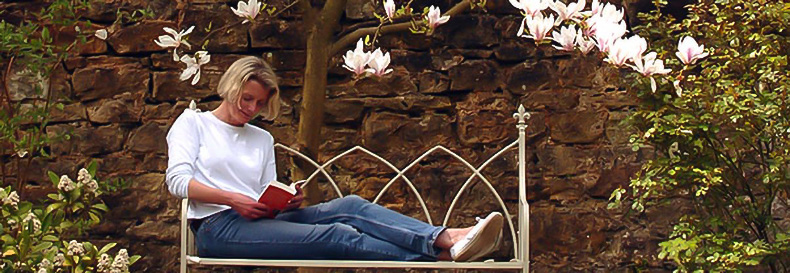
There are two; on the big swing in the garden where I can gently rock and look out over the beautiful valley (see it on my website www.wendyholden.net). Otherwise, there's a little sitting room in my house with bookcases, CDs and two big red armchairs with footrests. It was designed as a room to read and listen to music in and the children aren't allowed to come in it (but they do, all the time!)

17. What is your favorite snack food?
Cheese and onion crisps, preferably Seabrook's. Though I can always make room for bagel chips as well. And I love biscuits. And sometimes, when you want that little tang of something salty halfway through the morning, there's nothing quite like a forkful of Parma ham. Oh, and fries are irresistible too, and a handful of pistachios, especially with raisins, is delicious . And I've just made some small cakes with my daughter with pink buttercream icing and silver dragees, which fill in that space between lunch and supper…excuse me, I just had to go up to the house and get one.

18. What is your favorite season?
Spring, which is where we are at the moment. It's such a huge relief after what seemed an endless winter, with Arctic snowfall. I couldn't get the car out and the children had to go to school by sledge. But now all the narcissi are coming out, the pink camellia are emerging and the woodland paths are dry, as Yeats says. Perhaps, like me, he got fed up of trudging round in the mud all the time.

19 Do you have a schedule for writing each day or do you just do it when you can?
Before I wrote full-time I worked as a journalist as well and had to write in the mornings before work and also throughout the holidays. It was a pretty miserable experience, especially for my husband, and now it's such a privilege to be able to write all day every day and have proper holidays.

20. Where do you do the majority of your writing?
When we bought this house there was a small wooden summer house in the garden, crammed with junk. I cleared it out, built on an extra room (not personally, I'm not the DIY type) and now it's my writing hut. It's quite glamorous, with fairy lights, rugs, a bust of Shakespeare, a pink telephone, a chaise longue, lots of pictures, a phrenologist's head and a turntable with a collection of Nat King Cole LPs. Oh, and shelf upon shelf of books; all my foreign editions mostly. It's thrilling to look up and see my titles in Russian and Japanese! But I have to say that apart from the computer the heater is the most essential piece of kit; in winter I come in to find the water in my bottle frozen!

21. You have had a variety of writing/editing jobs, what is one of the funniest stories you can share from working in that world of publishing?
Well once I worked for a very grand glossy magazine editor who asked me if I knew the difference between aristocratic legs and legs that belonged to ordinary people. She then went on to describe the former; long, thin and with the knee equidistant between the hipbone and the ankle bone. She then explained that ordinary people, by contrast, have a long thighbone and a short calf and their legs tend to be chunkier. Looking round the office, it seemed to me that most of the girls there had the ordinary sort of leg, even though they all saw themselves as practically royal.

22. Do you have a new book in the works?
I certainly have. I've just finished Gallery Girl, which is a comedy about contemporary art. My heroine works in an ‘edgy' gallery full of hairy pebbles and wheelchairs sprayed gold. There are some great characters including a rock n roll bad boy artist and a wealthy art buyer who expects a lot more than just paintings from the artists she patronises!

Decorative dividing device

Q & A

I recently answered the following questions for the Daily Express

Food: Always the same or always game?

I've spent a lifetime honing my skills as an eater and am now staggeringly accomplished. And while I'll tackle anything apart from snails, ketchup and sheep's eyeballs, I particularly adore garlicky scallops in the shell served with big fat chips, as at my favourite restaurant in Cornwall.

Cooking: Experimental or tried & tested?

My husband Jon is the cook in our family – he can rustle up practically anything and makes a mean saltimbocca alla Romana. I love writing about food, though, it's such a sensual subject. My new novel is partly set in Italy and has a fabulously sexy chef in it.

Clothes: M&S or D&G?

I've got both, but more of the former. But I love expensive clothes; it's amazing how they make you feel in control. A recent, potentially difficult trip by train from Antibes, across Paris and back to London with the children and luggage was transformed when I wore my best spotty wrap dress, my new gold cuff and painted toes.

Fashion: victim or setter?

I aim to pass muster really. I find a smart white shirt, skinny jeans and boots get me through most situations. But I love the whole circus of fashion – it's so funny, all those absurd-looking people telling everyone else what to wear. I get enormous comic inspiration for my work from it.

Shopping: ‘til you drop or avoid at all costs?

I love shopping. Particularly shops that sell glamorous, impractical, delightful things such as Jo Malone or Diptyque. I also adore John Lewis and feel nothing bad could ever happen to you there. I even enjoy going to the supermarket because it's such a great opportunity for people-watching and gives me ideas.

Holidays: Beach or piste?

I loathe the whole idea of active or adventure holidays. Life is exhausting enough; when I'm having a break I want to relax with lots of good wine, food and, hopefully, weather. There are places I love and go back to again and again – the south of France, Venice, Cornwall, north west Scotland, Paris. Why go anywhere else?

Approach to Life: Manana or right now?

I've got too much to do to leave it until tomorrow. Right now at the moment it's usually raining anyway;good working weather.

Friends: quantity or quality?

I've known most of my friends for ages, some right back to university and a couple even from school. Oldies but goodies.

Entertainment: Intimate Dinner or Big Bash?

I'm not a big dinner party person unless it's a gathering of close friends. I love big occasions though – weddings, christenings, parties – when I can dress up, drink champagne and generally get very overexcited.

Drink: Beer or Bolli?

How can you even ask! See answer above; I think champagne is one of life's greatest pleasures. Among its many virtues is its ability to make you feel suddenly full of energy, as well as witty, fascinating and thin.

Housekeeping: Aggie & Kim or Wayne & Waynetta?

I spent years in a tiny, scruffy flat where being tidy was the only way to make it look bearable. I'm still tidy now; it makes me feel I have some control over life. Of course it's an uphill struggle with two small children and there are some days when you feel you are just following them around with a sponge or a dustpan and brush. Possibly because you are.

Cars: Boy racer or Sunday driver?

I like driving but, again because of children, we drive a solid family estate rather than anything flash. Possibly that's a good thing – people over forty rarely look as glamorous as they think they do in open-topped sports cars. And those bald middle-aged blokes who roar around in yellow Lotuses are simply pitiful.

Money: Rainy day or live for today?

I was a rainy day person but then I lost loads in Northern Rock and my shares nosedived. But I'm basically pretty responsible and my inner Mr Micawber would never let me live beyond my means. The real answer though is that, while I enjoy luxury, I know there are more important things in life than money.

Property: Urban chic or rural retreat?

I'm fortunate to have both – I kept the small flat in King's Cross where I lived when I was a journalist and my house in Derbyshire has a wonderful garden where I work. I adore city and country equally, although could never write in London now, it's far too fascinating and distracting! I do fantasise, though, about a holiday home on the Riviera.

Décor: minimal or cosy?

White walls are crucial; I love paintings and buy them whenever I can afford to. Art, rather than shoes, is my real shopping vice. Apart from that, lots of bookshelves, sisal floors and enormous, comfortable beds are essential. Oh, and the biggest bathroom possible.

Children: Mary Poppins or Cruella De Vil?

Neither. I have studied both ladies in some considerable depth over many, many viewings, courtesy of the children. The type of mother I aspire to be is, as it happens, another Disney creation; Duchess out of the Aristocats is an ideal mixture of charm, kindness, courage and humour, as well as enormous glamour.

Health: alternative or aspirin?

Aspirin for a headache. Otherwise, I firmly believe garlic is brilliant for health, which probably isn't brilliant for the people round me.

Rubbish: bin it or recycle it?

Recycle; it's incredible the amount we build up over a week. I once had the embarrassing experience of meeting our doctor as I shoved endless empties into the bottle bank.

Fitness: Jane Fonda or Jim Royle?

The pool of the local health club is relatively empty at lunchtime, so I cattle-prod myself there a few times a week. I also do Pilates to help with my writer's back; my instructor's a former ballerina which adds a bit of glam to things.

Technology: gadget man or technophobe?

I used to be a phobe; it took me longer to send a text than it would to write it in copperplate. But I've sharpened up my act and am about to launch my own personal website, wendyholden.net, which I see as a sort of cyber cocktail party where at the moment I'm hovering around the door, checking my make-up in the hall mirror and wondering who will turn up.